


Roof fixings do a lot of heavy lifting, quietly. They hold sheets in place through wind uplift, vibration, and temperature swings, and in many cases they also help maintain a weather-tight seal. When fixings fail, the problem rarely shows up as a neat, obvious break. It tends to appear as leaks around a handful of points, sheets that start to rattle in strong wind, rusty staining, or sections that loosen over time. The frustrating part is that most of these failures are preventable. If you are choosing roof screws, it helps to understand why roof fixings usually fail in the real world, because the wrong choice or a small installation mistake can shorten the life of the whole job.
The aim is not to obsess over every specification. It is to avoid the handful of issues that cause most call-backs and repairs.
Using The Wrong Screw For The Substrate
The most common failure starts right at the beginning: a screw designed for one type of fixing is used for another. A roof sheet fixed into timber needs a screw that is meant to bite properly in wood. Fixing into steel purlins needs a screw with a drill point and thread profile suited to steel.
When the screw does not match the substrate, it can still appear to go in fine, but the hold is compromised. In timber, the thread can fail to grip properly if the screw is not suited to wood, leading to looseness over time. In steel, using an unsuitable drill point can cause the screw to struggle, overheat, or form a weak thread, which can strip under load. The sheet might feel tight on the day, but it does not stay tight when the roof starts moving through seasons.
Prevention is simple: know what you are fixing into, and make sure the screw is designed for that exact scenario. Timber and steel are not interchangeable, and neither are different thicknesses of steel.
Choosing A Drill Point That Can’t Handle The Steel Gauge
Even when you pick a self-drilling fixing, the drill point still needs to match the thickness of the steel. If the point is not designed for the gauge you are drilling into, you end up forcing the screw. That creates heat, blunts the point, and increases the chance of snapping or stripping.
You also get inconsistent fixings. One might go in nicely, the next might spin, and another might snap. In roofing, inconsistency is a warning sign because it means the roof is not uniformly secure.
The fix is to match the drill capability to the steel thickness rather than assuming all “self-drillers” behave the same. When the drill point is correct, the screw cuts cleanly and forms a reliable thread without brute force.
Over-Tightening And Crushing The Seal
When roofing screws include a bonded washer, that washer is part of the weatherproofing. It needs to compress evenly to create a seal. One of the most common causes of leaks is over-tightening. People often assume more torque equals more security, but on a roof it can do the opposite.
If you crush the washer, you can deform it, split it, or squeeze it out so the seal is no longer consistent around the hole. You can also deform the sheet profile, creating a small channel where water can track. In some cases, over-tightening strips threads in the substrate, so the screw feels tight but is actually compromised.
A properly seated washer looks evenly compressed, not flattened into the sheet. The best prevention is controlled driving, keeping the screw square to the surface, and stopping once the washer is seated firmly.
Under-Tightening And Leaving Movement
The opposite mistake is under-tightening. If the washer does not seat properly or the screw is left slightly loose, the sheet can move. That movement might be tiny, but repeated wind loading and vibration can enlarge the hole, wear the washer, and loosen the fixing further. Over time, the roof starts to rattle, or a small leak appears at a few points.
Under-tightening often happens when people rush, use the wrong bit, or struggle with the drill point and back off too early. It can also happen when the driver is not consistent across the job.
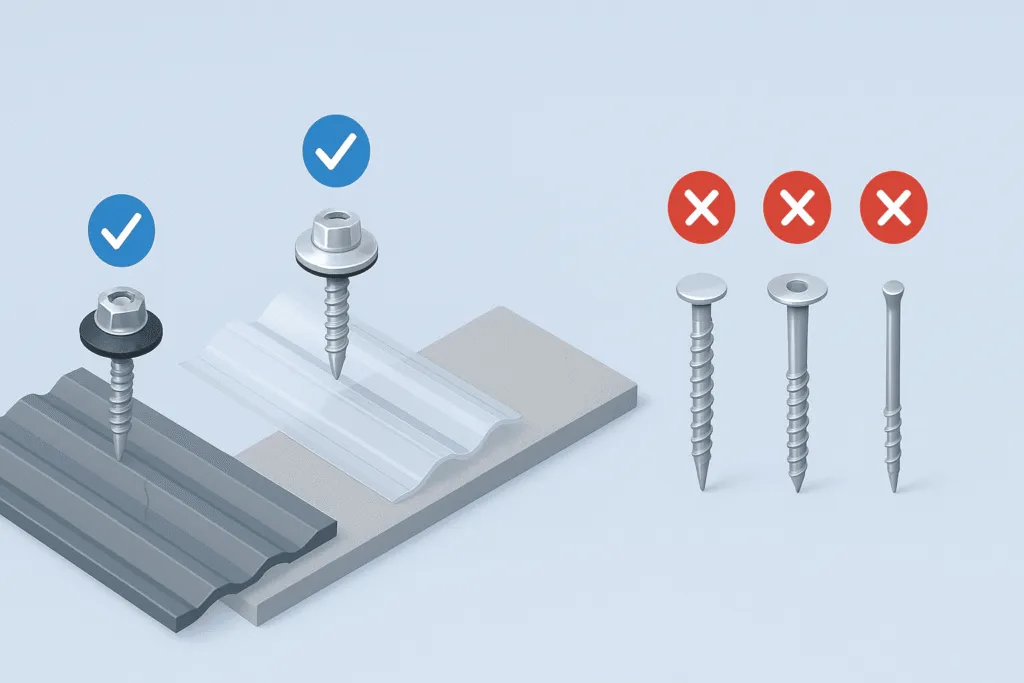
Prevention is, again, consistency and control. Each fixing should be seated properly, square, and tightened to a firm finish without crushing the washer.
Driving At An Angle
A screw driven at an angle is a common silent failure. Even if it holds, the washer compresses unevenly and the seal is weaker on one side. That can allow water to creep in, especially under wind-driven rain.
Angled driving also increases stress on the screw and thread. Over time, that can contribute to loosening, especially where the roof experiences movement.
This is often prevented by taking an extra moment to line up properly, using the right extension, and avoiding awkward driver angles wherever possible. If access makes square driving difficult, it is worth adjusting your position rather than trying to muscle it in
Poor Corrosion Resistance Or A Mismatch In Materials
Roof fixings live outdoors. If the screw’s coating or material is not suited to the environment, corrosion can start earlier than you expect. You might first notice rust staining around fixings or discolouration on the sheet. Once corrosion takes hold, it weakens the fixing and can compromise the seal around the hole.
Another issue is mixed metals. When different metals meet in wet conditions, galvanic corrosion can speed up failure. The screw, washer, and sheet should be compatible for the environment the building sits in, particularly in coastal, agricultural, or industrial settings where corrosion risk increases.
Prevention here is choosing fixings designed for exterior use and appropriate to the local conditions, rather than assuming any screw is “good enough” because it fits.
Incorrect Length And Poor Thread Engagement
A roof screw needs enough length to go through the sheet and washer and still achieve proper engagement in the substrate. If it is too short, it may barely bite, making the fixing more prone to loosening. If it is excessively long, it can be awkward, introduce flex, or create issues below the sheet line.
The main point is engagement. A secure fixing needs sufficient thread holding where it counts, whether that is timber or steel. If the thread is only catching lightly, it is far more likely to fail under wind uplift or vibration.
Choosing length should be about the real stack of materials: sheet profile, washer, and substrate thickness, not guesswork.
Installation Choices That Create Weak Points
Fixings do not exist in isolation. Pattern and placement matter. When screws are not installed consistently, or when they are placed in the wrong part of the sheet profile, stress concentrates in the wrong places. That can lead to movement, noise, and eventually loosening.
The best jobs look boring because they are consistent. The sheets are fixed in the correct locations, the spacing is uniform, and each screw is seated properly. That uniformity spreads loads and keeps movement under control.